Powering Down: What a Distressed AI Data Center Might Look Like in Chapter 11
By Jason Rosell and Brooke Wilson, Pachulski Stang Ziehl & Jones LLP November 19, 2026The Boom, the Backlash, and the Case for Looking Ahead
Few sectors have absorbed capital as fast as AI infrastructure. Hyperscalers, neocloud GPU operators,[1] and a cohort of former bitcoin miners are collectively committing hundreds of billions of dollars to campuses measured in gigawatts,[2] and economists now credit AI-related investment with a meaningful share of U.S. GDP growth.[3] The financing has generally kept pace, taking the form of GPU-backed term loans, project-level secured notes issued from bankruptcy-remote subsidiaries, multi-billion-dollar convertible issues, and preferred equity facilities from infrastructure funds.[4]
A public backlash to the development of AI infrastructure has formed just as quickly. On August 3, 2026, Texas Governor Greg Abbott imposed a moratorium on new data center grid approvals pending an Electric Reliability Council of Texas (“ERCOT”) audit.[5] Seven weeks later, on September 21, he directed the Texas Commission on Environmental Quality to halt all data center permits, and told other state agencies to stand down on data center approvals, until ERCOT and the Texas Water Development Board complete their reviews.[6] Those directives may now be extended rather than lifted. On November 3, Abbott lost his reelection bid to Democrat Gina Hinojosa, who takes office on January 19, 2027 and who pledged during the campaign to impose a moratorium on all data center approvals until the Legislature enacts new protections.[7] Texas is not alone. New York has imposed a statewide moratorium on hyperscale facilities.[8] By one industry tracker’s count, twelve governors from both parties signed orders restricting data center development in 2026, four of them in September alone.[9] Local governments have moved faster still: Anne Arundel County, Maryland voted 7–0 on October 5 to pause new applications through January 2028,[10] and a cluster of Colorado jurisdictions adopted moratoria this year, several keyed to facilities drawing 10 MW or more.[11] Data Center Watch counted at least 75 projects worth roughly $130 billion blocked or delayed in the first quarter of 2026 alone, matching all of 2025.[12] Anthropic has even called out these moratoriums noting that they “could delay or prevent the construction or expansion of facilities on which [Anthropic] depend[s] for compute.”[13] The November 3 midterms confirmed the trend. Democrats who campaigned against data centers also flipped the governorships of Ohio, Georgia, Nevada, and Iowa,[14] and by one count voters sided against data centers in all but one of 41 local ballot measures across ten states. The regulatory bottleneck is unlikely to loosen soon.[15]
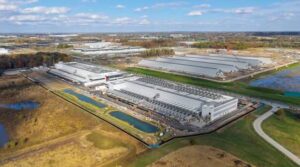
Image Provided from Construction Today
The question is not whether a major AI data center operator will land in chapter 11, but what the case will look like when it does. Restructuring professionals will recognize the resulting recipe: capital intensive projects, long-dated fixed obligations, fast-depreciating equipment, concentrated counterparties, and a regulatory environment that can strand a half-built campus. This article offers a primer on how the industry is built and flags the issues most likely to define that case.
How the Industry Is Built
The industry runs on three business models, and the distinction matters because each produces a different capital structure and a different set of contracts to fight over.[16]
- The Owner-Operator Model / Hyperscalers. Entities that fall within this business model are typically hyperscalers – large-scale cloud service and infrastructure providers that build and run facilities for their own workloads. Examples include Amazon, Microsoft, Alphabet, and Meta. These hyperscalers are unlikely near-term chapter 11 debtors; however, hyperscalers are important counterparties in the AI data center industry’s capital structure.
- The Landlord Model. The second model is to build a “powered shell” or turnkey capacity and lease it, often on 10- to 20-year triple-net, take-or-pay terms, to a tenant that installs its own servers.[17] In other words, the landlords provide the land with power, grid connections, and substations, but leave the GPU risk (e., the cost of buying the chips and the risk that they lose value or become obsolete) to someone else.[18] Their revenue is rent, their principal risk is tenant credit, and their debt is typically project-level secured notes ring-fenced in special-purpose subsidiaries. The commitments on the tenant side of those contracts are just as large. For example, Anthropic reports approximately $900.9 billion of purchase and lease commitments, including roughly $451 billion of leases that have been signed but have not yet commenced, with terms of up to 20 years and a weighted average of around 10 years.[19],[20]
Examples of this business model include Core Scientific, Hut 8, Applied Digital, TeraWulf, Cipher Mining, and Riot Platforms, several of which are current or former bitcoin miners, highlighting the unique advantage that miners have in this space. Miners spent a decade assembling the one input AI cannot buy quickly: grid-connected power at scale, with land, substations, and interconnection approvals already in hand. A mining site with 200 MW of approved load can become an AI campus years faster than a greenfield (i.e., a project built from scratch on undeveloped land with no existing power or grid connection).[21]
Core Scientific is the template for this transition. Once the largest North American miner, it filed chapter 11 in December 2022 (Bankr. S.D. Tex.),[22] emerged in January 2024 with more than a gigawatt of contracted power,[23] and by mid-2026 had leased roughly 590 MW of it to CoreWeave.[24] Hut 8 has similarly repositioned itself as a hyperscale campus developer, reporting $16.8 billion of contracted triple-net, take-or-pay lease revenue,[25] and was recently announced as the successful bidder in Poolin Technology (Bankr. D.N.J.) on two mining-era data center sites.[26] These examples show that in any miner or legacy-operator case, the power purchase agreements, interconnection rights, and permits – not the rigs, and often not the buildings – are the estate’s most valuable assets, and the sale process should be designed around them.
3. The Neocloud Model. The third model is to buy the GPUs and sell the compute, either by the hour or under multi-year committed-capacity contracts, to AI labs, enterprises, and the hyperscalers. Neoclouds finance the purchase of GPUs through delayed-draw term loans secured by the GPUs or convertible notes and the underlying customer contracts.[27] CoreWeave and Nebius occupy this category. Because of ever-advancing technology in this space, neoclouds carry the hardware obsolescence risk – that a newer and better GPU will be released making the prior generation obsolete.[28]
The Players
The following public companies are key players in the space. Figures are drawn from recent periodic reports and earnings releases, are approximate, and in several cases predate additional borrowing.
| Company | Role in the AI buildout | Funded debt (approx.) |
| CoreWeave (CRWV)[29] | Pure-play neocloud; leases nearly all facilities; GPU- and contract-backed project loans | $35.6B principal at 6/30/26, plus ~$16B of lease liabilities; ~$6.8B raised since |
| Nebius (NBIS)[30] | Vertically integrated neocloud; builds and owns its data centers | ~$10B at 6/30/26, before $5.75B of August 2026 converts |
| Applied Digital (APLD)[31] | Purpose-built HPC landlord (high-performance computing); CoreWeave is anchor tenant | ~$6.7B at 8/31/26, incl. $2.35B 9.25% secured notes due 2030 at an SPV |
| Core Scientific (CORZ)[32] | Former miner turned colocation landlord; CoreWeave ≈ 77% of revenue | $4.3B long-term debt; $7.7B total liabilities vs. $5.3B assets at 6/30/26 |
| Hut 8 (HUT)[33] | Former miner; hyperscale campus developer; $16.8B of NNN take-or-pay leases | ~$7.6B, substantially all non-recourse project notes at bankruptcy-remote subsidiaries |
| TeraWulf (WULF)[34] | Former miner; HPC hosting (Fluidstack, with Google backstop) | $5.8B at 3/31/26 ($2.5B parent converts; $3.2B project notes) |
| Cipher Mining (CIFR)[35] | Former miner; HPC campuses (Barber Lake, Black Pearl, Stingray) | ~$6.0B at 6/30/26, incl. $4.5B secured project notes |
| IREN (IREN)[36] | Former miner; owns land, substations, interconnections; AI cloud (Microsoft) | $7.7B principal at 6/30/26 ($6.7B converts) |
| Riot Platforms (RIOT)[37] | Former miner; Rockdale, Tex. campus; 20-year, 191 MW lease (~$9.1B) with an AI lab | ~$0.6B converts due 2030, plus $573M interim facility |
Two features recur across the table. First, leverage arrived fast. Nebius’s total debt went from about $30 million in September 2024 to roughly $10 billion by June 2026, and IREN’s principal rose from under $1 billion to $7.7 billion in a year, most of it convertible notes.[38] Second, much of that debt is structured as non-recourse project debt at bankruptcy-remote subsidiaries – a structure that tends to be tested rather than respected once the parent is distressed.
A Hypothetical Case
To see how the industry’s pressure points could play out in practice, consider a hypothetical in which a leveraged neocloud like CoreWeave were to seek chapter 11 protection. According to CoreWeave’s 2025 Form 10-K, it leases essentially all of its data centers, generally for terms of 5 to 15 years, while its customer contracts generally run one to six years.[39] It bridges that duration gap with debt. As of June 30, 2026, it owed $35.6 billion of principal, $13.6 billion of it project loans secured by GPUs and customer contracts,[40] on top of roughly $16 billion of operating lease liabilities.[41] Second-quarter interest expense of $558 million consumed about 22% of revenue, and the company’s current debt exceeded its cash.[42] By one analysis, 42% of its principal comes due by the end of 2028.[43] The market has taken notice. In mid-October 2026 its 9.625% unsecured notes due 2032 traded to yield roughly 15%, the equity sold off sharply, and the contagion spread to Nebius, Hut 8, Cipher, TeraWulf, and IREN.[44] Others, like Elon Musk, are also taking notice with Musk predicting that “200+ neoclouds are going to see guppy-level death and consolidation.”[45]
The customer contracts that support this debt may also be less firm than their headline values suggest. Anthropic, a major buyer of compute, discloses that approximately $186.2 billion of its commitments are subject to termination rights or to conditions such as the counterparty’s ability to secure financing, facilities, or regulatory approvals.[46] Its agreements with GPU cloud providers Nscale and Lambda, for up to approximately $44.6 billion and approximately $41.3 billion, provide that fees accrue only as capacity is delivered and accepted, and a Lambda agreement representing about $34.9 billion of that total is currently terminable by either party because Lambda did not secure the facility lease by the agreed date.[47] A lender whose collateral includes a contract of this kind is relying on the debtor’s continued ability to finance, build, and deliver the capacity. Credit support can also run from the customer back to the developer: Anthropic reports up to $4.2 billion of cost reimbursement exposure to data center developers, triggered by events such as a developer’s failure to obtain construction financing.[48]
There’s also risk from the landlord perspective. Applied Digital’s Ellendale leases to CoreWeave run approximately fifteen years with three five-year extension options, cover hundreds of megawatts of purpose-built critical IT load, and are financed in part through $2.35 billion of 9.25% senior secured notes due 2030 issued by a special-purpose subsidiary.[49] Core Scientific’s second-quarter 10-Q discloses that CoreWeave accounted for about 77% of its first-half revenue and all of its colocation revenue, and acknowledges that its practical ability to enforce recourse against CoreWeave would “depend on its financial condition at the time of any default.”[50] Core Scientific itself reported $7.68 billion of liabilities against $5.26 billion of assets at June 30.[51] The two companies’ $9 billion merger – announced in July 2025 and voted down by Core Scientific’s stockholders that October – would have internalized the risk. Instead, that risk now sits across a fifteen-year lease.[52]
This type of hypothetical fact pattern is also not entirely new. Cyxtera Technologies, a colocation provider that leased all but two of its roughly 60 data centers from 28 different landlord groups, filed chapter 11 in the District of New Jersey in June 2023 and was ultimately sold to Brookfield, which also bought the underlying real estate at seven key sites directly from the landlords.[53] Along the way it rejected leases in Moses Lake, Amsterdam, Chicago, and Santa Clara, some with eleven to fourteen years remaining, and at least one of which had been pledged as collateral in the landlord’s asset-backed securitizations.[54] Cyxtera was small by today’s standards, but its issues will likely return at scale.
Issue One: What Kind of “Lease” Is It?
The most consequential characterization question in an AI data center case is likely whether a facility agreement is a lease of non-residential real property, a lease of personal property, or a disguised financing. The Bankruptcy Code treats each differently.
If it is a real property lease, the debtor must timely perform postpetition obligations under section 365(d)(3) and must assume or reject such lease within 120 days (extendable once for 90, then only with landlord consent) under section 365(d)(4), which gives landlords real leverage early in the case.[55] On the other hand, landlords face risk if their leases are rejected. Under section 502(b)(6), the landlord’s rejection damages are capped at the rent reserved for the greater of one year, or 15%, not to exceed three years, of the remaining term of such lease, plus unpaid prepetition rent.[56] Courts remain divided on whether “15%” measures rent or time, though the trend favors the time approach.[57] However, either way, a landlord with thirteen years left on a fifteen-year lease – the Cyxtera and Applied Digital fact pattern – recovers at most three years of rent as a general unsecured claim on its rejection claim.
If instead it is a lease of personal property, section 502(b)(6) does not apply and the rejection claim is uncapped. In return, the debtor gains flexibility. The debtor’s postpetition performance obligation does not begin until day 60 of the case under section 365(d)(5), and the debtor may defer the assume-or-reject decision – and the cure – to plan confirmation.[58] Finally, if the agreement is a disguised financing rather than an executory contract, then section 365 does not apply at all.[59] The counterparty is instead a secured creditor whose claim could be bifurcated under section 506(a) and subject to cramdown, and recovery turns on collateral value rather than contract rent.[60]
AI data center agreements, moreover, are built to resist easy classification. Riot’s 20-year, 191 MW Rockdale agreement, for instance, is styled a “Data Center Lease and Services Agreement.”[61] The typical agreement conveys a building shell, but also a defined quantity of delivered critical IT load, the electrical and cooling plant required to deliver it, and operations services, with rent that scales to megawatts rather than square feet. Anthropic’s disclosures show the same blending from the customer’s side. Certain of its dedicated power and data center arrangements have initial terms of 20 years with annual escalators, take-or-pay compute payment obligations, and uncapped fuel cost pass-throughs.[62] Its five-year master equipment leases with Broadcom, representing approximately $161.2 billion of rent, are accounted for as finance leases, are secured by the leased equipment, sit in special-purpose subsidiaries under a parent guaranty, and have been assigned in part to financing entities.[63],[64] Courts asked to classify such hybrid agreements may need to look to state law and economic substance to determine whether a particular agreement is a lease of non-residential real property, a lease of personal property, or a disguised financing. Tenants, landlords, and the securitization investors behind them should therefore assume that the label of the agreement will not control how such agreement is treated under the Bankruptcy Code.
Issue Two: Power, Interconnection, and the Search for Unencumbered Collateral
Every DIP lender’s first question is what is unencumbered. In this sector the answer may lie in rights that could not be pledged outside bankruptcy. Large-load interconnection agreements and queue positions are creatures of utility tariffs and ISO/RTO[65] rules, typically tied to a specific applicant and site and transferable only with the utility’s consent. Air and water permits, and in Texas the approvals contemplated by the state’s 2025 large-load legislation,[66] are similarly operator-specific. Power purchase agreements frequently require counterparty consent to assign. Yet these rights are precisely what made Core Scientific worth a $9 billion bid, and what underwrites Riot’s roughly $9.1 billion lease, which the company premised on its existing, fully approved Rockdale interconnection.[67]
The closest analogy may be a liquor license. Many states prohibit a lien on the license itself, so lenders take a lien on proceeds, pledge the equity of the licensee, and rely on bankruptcy’s assumption-and-assignment machinery to realize value in a sale.[68] The Bankruptcy Code may offer DIP lenders similar tools here. Property of the estate under section 541 is broad enough to capture contingent, nontransferable rights. Section 364(c)(2) authorizes liens on unencumbered property, and section 365(f)(1) overrides contractual anti-assignment clauses – subject to section 365(c)(1), which preserves applicable-law excuses.[69]
To our knowledge, no reported decision squarely addresses whether a DIP lien can attach to a load interconnection position, or what happens when a utility declines to recognize a lender’s step-in rights. Until one does, lenders and debtors should consider this gap. Lenders may be inclined to take liens on the proceeds of any assignment or sale, obtain pledges of the equity in the project subsidiary that holds the interconnection, permits, and PPAs, negotiate section 364(c)(1) superpriority claims sized to the sale value of the power position, insist on milestones requiring prompt assumption and assignment under section 365, and engage early with the utility and the ISO. The power position may well be the most valuable asset in the case, and the financing should be structured as if it were.
Issue Three: Keeping the Lights On — Utility Motions Under § 366
Power is a data center’s largest operating cost and its most critical input, so the first-day utility motion may matter more here than in almost any other chapter 11 case. An initial issue will be whether section 366 applies. The statute may not reach a bilateral PPA counterparty or independent generator that is not a “utility” in the section 366 sense, and those parties’ remedies would run through section 365 instead. That gap is a practical one. Anthropic describes procuring power in some cases through behind-the-meter generation that supplies a facility directly rather than through the grid, and it has guaranteed up to $500 million of a data center provider’s payment obligations under a power purchase contract.[70] Retail electric providers in deregulated markets present a closer question. At least one bankruptcy court has held that a Texas retail electric provider is a “utility” under section 366 even though it competes with other providers, reasoning that deregulation replaced a regulated monopoly with a regulated oligopoly.[71] Another court, in a different context, concluded that a competitive electricity supplier was not a utility in the traditional sense because the debtor could obtain power elsewhere.[72] A retail provider may also argue that its supply agreement is a forward contract, and the interaction between the Bankruptcy Code’s forward contract safe harbors and section 366 remains unresolved.[73]
If section 366 applies, then a debtor must carefully consider what constitutes “adequate assurance of payment.”[74] Section 366 lets a utility serving a debtor discontinue service only on narrow terms. For the first 20 days after the petition date, the utility may not alter, refuse or discontinue service, or discriminate against the debtor, solely because the case was filed or because prepetition bills are unpaid.[75] After that, the utility may stop service only if the debtor has not provided “adequate assurance of payment.”[76] In a chapter 11 case, that assurance is a deposit or other security that the utility finds satisfactory, commonly a two-week deposit, and it must be received by the utility provider within 30 days after the petition date.[77]
For a utility, the statute has real advantages. It gives the utility a statutory right to demand security. It also gives the utility an effective hold on a customer that cannot tolerate an outage, and it shields the utility from having to extend unsecured postpetition credit. The same statute cuts the other way. The utility must keep serving during the statutory window regardless of any unpaid prepetition utility bills. It remains bound by its tariff and by state and regional utility rules, which may limit what it can demand or when it can disconnect. The court can also reduce a demanded deposit it finds excessive.[78]
The exposure is unusually large in this sector, because a single campus can draw hundreds of megawatts around the clock, so even a short deposit period can mean a very large dollar figure. Some utilities have already built collateral and minimum-demand requirements into their large-load tariffs, and a debtor may argue those protections already give the utility adequate assurance. The debtor’s own leverage also varies. In deregulated markets such as ERCOT, the debtor can often switch retail electric providers, while in a regulated territory the utility may be the only source. For that reason, debtors should consider sizing the proposed deposit against actual demand and not relying on a boilerplate motion. Given the large amounts at stake, practitioners might see utility providers coming to first-day hearings with documented exposure analysis.
Conclusion
The AI buildout is real, and so is the backlash now constraining its single most important input – power. Together they make a distressed data center case a matter of when, not if. The issues that case will present – hybrid leases that fit no Bankruptcy Code category cleanly, project debt stacked in bankruptcy-remote silos, estate value concentrated in regulatory rights that resist conventional liens, and significant utility exposure – are knowable now. Practitioners who work through them before the first petition is filed will be better positioned than those who start on the petition date.
Disclosure: This article was drafted with the assistance of AI.
[1] “GPU” means graphics processing units and are the specialized computer chips used to train and run AI models.
[2] Paul E. Soto, Mason Thieu, & Jeffrey S. Allen, The AI Buildout and the Economy: Publicly Available Data to Assess AI’s Impact, Board of Governors of the Federal Reserve System (July 17, 2026) [hereinafter Fed. Reserv. Note], https://www.federalreserve.gov/econres/notes/feds-notes/the-ai-buildout-and-the-economy-publicly-available-data-to-assess-ais-impact-20260717.html (compiling hyperscaler capital expenditure and Census data center construction data); Niqui Kohli, Yulia A. Solomakhina, Albert Alsaygh, Brett Pearlman, & Dean Luo, Financing the Data Center Boom: The Investment Opportunity, the Risks, and the Capital Solutions Taking Shape, Cleary Gottlieb (Sept. 11, 2026) [hereinafter Financing the Data Center Boom], https://www.clearysecuritieswatch.com/2026/09/financing-the-data-center-boom-the-investment-opportunity-the-risks-and-the-capital-solutions-taking-shape/.
[3] Hannah Rubinton & Bontu Ankit Patro, Tracking AI’s Contribution to GDP Growth, Fed. Reserve Bank of St. Louis (Jan. 12, 2026), https://www.stlouisfed.org/on-the-economy/2026/jan/tracking-ai-contribution-gdp-growth (AI-related investment categories contributed significantly to 2025 real GDP growth, exceeding the dot-com-era IT contribution); Fed. Reserv. Note (AI-related components contributed meaningfully to quarterly GDP growth from 2025 through Q1 2026); see also James Knightley, How Much Is AI Contributing to US Economic Growth?, ING Think (Aug. 19, 2026), https://talkmarkets.com/article/how-much-is-ai-contributing-to-us-economic-growth-1787193106 (ING estimates roughly one-third of 2026 U.S. GDP growth is attributable to AI-related investment after netting imports).
[4] See e.g., CoreWeave, CoreWeave Closes Landmark $8.5 Billion Financing Facility, Achieving First Investment-Grade Rated GPU-backed Financing (Mar. 31, 2026), https://investors.coreweave.com/news/news-details/2026/CoreWeave-Closes-Landmark-8-5-Billion-Financing-Facility-Achieving-First-Investment-Grade-Rated-GPU-backed-Financing/default.aspx (non-recourse delayed-draw term loan secured by HPC infrastructure); Applied Digital, Applied Digital Reports Fiscal Second Quarter 2026 Results (Jan. 7, 2026), https://ir.applieddigital.com/news-events/press-releases/detail/142/applied-digital-reports-fiscal-second-quarter-2026-results ($2.35 billion of 9.25% senior secured notes issued by a special-purpose subsidiary; preferred equity facility of up to $5.0 billion from Macquarie Asset Management); IREN, IREN Closes $3.0 Billion Convertible Notes Offering (May 14, 2026), https://www.globenewswire.com/news-release/2026/05/14/3295320/0/en/iren-closes-3-0-billion-convertible-notes-offering.html (announcing the closing of its offering of $3.0 billion aggregate principal amount of 1.00% convertible senior notes due 2033).
[5] Isabel O’Brien, Texas Gov. Abbott orders data center permit halt weeks after issuing moratorium, CNBC (Sept. 21, 2026, at 18:36 EDT), https://www.cnbc.com/2026/09/21/texas-governor-abbott-ai-data-center-permits.html (audits ordered in August together with moratorium on new grid approvals).
[6] Governor Abbott Directs TCEQ To Halt Data Center Permits, Office of the Texas Governor (Sept. 21, 2026), https://gov.texas.gov/news/post/governor-abbott-directs-tceq-to-halt-data-center-permits.
[7] Emily Foxhall, Gina Hinojosa won the governor’s race. What happens to Texas data centers now?, The Texas Tribune (Nov. 4, 2026), https://www.texastribune.org/2026/11/04/data-center-texas-pause-gina-hinojosa-governor-policies/ (Hinojosa’s campaign statements went beyond Abbott’s current freeze, which is tied to an audit period expected to be completed this year).
[8] A Year of Monitoring: Anti-Data Center Narratives and Threats, The Soufan Center: IntelBrief (July 21, 2026), https://thesoufancenter.org/intelbrief-2026-july-21/ (New York enacted the first statewide moratorium on hyperscale data centers); N.Y. Exec. Order. No. 62 (July 14, 2026).
[9] Data Center Moratoriums (2026) — Which States Are Restricting Data Centers?, Electric Choice (last visited Nov. 6, 2026) https://www.electricchoice.com/datacenters/moratoriums/ (twelve governors — six Democrats and six Republicans — signed executive orders or directives in 2026.
[10] Benjamin Rothstein, Anne Arundel Council approves 15-month data center moratorium, The Baltimore Sun (Oct. 5, 2026), https://www.baltimoresun.com/2026/10/05/anne-arundel-council-approves-15-month-data-center-moratorium/; Anne Arundel Cty., Md., Bill 63-26 (Oct. 12, 2026) (https://www.aacounty.org/sites/default/files/2026-07/bill-63-26.pdf ).
[11] Savannah Eller, Monument places moratorium on data centers, following decision in Woodland Park, Colorado Springs Gazette (July 21, 2026), https://gazette.com/2026/07/21/monument-places-moratorium-on-data-centers-following-decision-in-woodland-park/ (Denver, Broomfield, Larimer County, Jefferson County, and Boulder County moratoria); see also Sara Wilson, Local governments in Colorado enact moratoriums on data center development, Colorado Newsline (Aug. 10, 2026), https://coloradonewsline.com/2026/08/10/colorado-moratoriums-data-centers/ (noting Broomfield counties 18-month moratorium on data centers using at least 10 MW).
[12] Q1 2026: Data Center Watch Report, Data Center Watch, https://www.datacenterwatch.org/q1-2026 (last visited Nov. 8, 2026).
[13] Lora Kolodny, Anthropic see U.S. data center moratorium as a key risk, CNBC (Oct 26, 2026 at 10:33 EDT), https://www.cnbc.com/2026/10/26/anthropic-ipo-live-updates-ai-s-1-filing.html.
[14] Marc Levy, Data centers took a beating in the midterm elections. A reckoning may be ahead for tech giants, Associated Press (Nov. 6, 2026), https://abcnews.com/Technology/wireStory/data-centers-beating-midterm-elections-reckoning-ahead-tech-137902293.
[15] See Isabel O’Brien, Texas Gov. Abbott orders data center permit halt weeks after issuing moratorium, CNBC (Sept. 21, 2026), https://www.cnbc.com/2026/09/21/texas-governor-abbott-ai-data-center-permits.html (“The data center buildout has been a breakout issue in the 2026 election, with a recent NBC News poll finding 64% of Americans would be less likely to vote for a candidate who ‘supports building local data centers.’”); Jennifer De Pinto, Data centers were not winners in the 2026 elections, CBS News exit polls find, CBS News (Nov. 6, 2026), https://www.cbsnews.com/news/exit-polls-data-centers-2026-election/ (“AI data centers were a major factor for over half of voters in the 2026 midterm elections.”); see also MacKenzie Sigalos, Voters rebuff data centers in every ballot measure except one during the 2026 midterms, CNBC (Nov. 4, 2026), https://www.cnbc.com/2026/11/04/data-center-ballot-measures-2026-midterm.html.
[16] See Financing the Data Center Boom (distinguishing hyperscalers operating facilities for their own workloads, colocation providers supplying “powered shell” to tenants, and “neocloud” GPU-as-a-service tenants).
[17] Junde Liu, Anchor tenant and colocation leases for AI data centers, Compute Law Blog (Aug. 23, 2026) [hereinafter Anchor Tenant and Colocation Leases for AI Data Centers] https://computelaw.blog/deals/anchor-tenant-colocation-leases-ai-data-centers/ (identifying three common categories for AI data center leases).
[18] Neocloud. Banks with GPUs., exoswan [hereinafter Neocloud Watchlist] https://exoswan.com/neocloud-stocks (last visited Nov. 8, 2026).
[19] Anthropic, PBC, Amendment No. 2 to Registration Statement (Form S-1) (Nov. 10, 2026) [hereinafter Anthropic S-1], https://www.sec.gov/Archives/edgar/data/2130357/000162828026072484/anthropicpbc-sx1ax2.htm (Management’s Discussion and Analysis – Contractual Obligations) (reporting aggregate commitments of approximately $900.9 billion, substantially all related to compute and infrastructure, and leases executed but not yet commenced of approximately $451.2 billion, generally expected to commence between 2026 and 2028).
[20] See e.g., GuruFocus News, Hut 8 Corp (HUT) (Q2 2026) Earnings Call Highlights, Yahoo Finance (Aug. 4, 2026) https://finance.yahoo.com/markets/stocks/articles/hut-8-corp-hut-q2-210219033.html (noting that the majority of the $7.6 billion financing Hut 8 secured “consists of the $3.25 billion Riverbend notes and $4.25 billion Beacon Point notes, which sit at bankruptcy-remote project subsidiaries and are non-recourse to the parent company”); Cipher Mining Q1 2026 earnings call transcript, The Motley Fool (May 5, 2026) https://www.aol.com/finance/cipher-mining-cifr-q1-2026-200613059.html (explaining that Cipher Mining’s debt is predominantly non-recourse and tied to contracted project assets); Applied Digital Reports Fiscal Second Quarter 2026 Results, Applied Digital Corp. (Jan. 7, 2026 at 16:48 EST), https://ir.applieddigital.com/news-events/press-releases/detail/142/applied-digital-reports-fiscal-second-quarter-2026-results (highlighting special-purpose subsidiary senior secured notes).
[21] See Michael Beno, Bitcoin Miners’ Biggest AI Deals of 2026, Ranked, OneMiners (Oct. 15, 2026) https://oneminers.com/blogs/news/bitcoin-miners-ai-deals-ranked-2026 (explaining why Bitcoin mining sites can make and are making an AI pivot); see also Ehteesham Ansari, Bitcoin miners pivot to AI and HPC as cryptocurrency market slumps, S&P Global: Market Intelligence (Feb. 25, 2026), https://www.spglobal.com/market-intelligence/en/news-insights/research/2026/02/bitcoin-miners-pivot-to-ai-and-hpc-as-cryptocurrency-market-slumps.
[22] In re Core Scientific, Inc., No. 22-90341 (CML) (Bankr. S.D. Tex.).
[23] See Vince Dioquino, Core Scientific emerges from bankruptcy, secures $55 million in new financing, Crypto Briefing (Jan. 8, 2024) https://cryptobriefing.com/core-scientific-emerges-bankruptcy-secures-55-million-financing/; CoreWeave’s $9B Bet on Core Scientific: Power Is the New Currency of AI, Global Data Center Hub (Oct. 1, 2025) https://www.globaldatacenterhub.com/p/is-coreweaves-9b-us-data-center-deal (writing that Core Scientific emerged from bankruptcy with “1.3 gigawatts of power capacity across nine U.S. sites”).
[24] See Core Scientific, Inc., Quarterly Report (Form 10-Q) (July 28, 2026).
[25] Hut 8 Corp., Form 8-K (Ex 99.1) (May 6, 2026) (reporting “$16.8 billion in triple-net, take-or-pay contracted lease revenue across two hyperscale AI campuses”).
[26] In re Poolin Technology PTE. LTD., et al., Case No. 26-18325 (EJO) (Bankr. D.N.J. Oct. 2, 2026), ECF No. 280. Pachulski Stang Ziehl & Jones LLP represents the Official Committee of Unsecured Creditors in this case.
[27] See StockTitan Editorial Team, CoreWeave Debt: $10.6 Billion Due Through 2027, Stock Titan (Oct. 28, 2026) [hereinafter CoreWeave Debt] https://www.stocktitan.net/articles/coreweave-nebius-ai-cloud-debt-when-it-comes-due (discussing CoreWeave, Nebius, and IREN’s capital structures); see also Junde Liu, Buying and allocating GPUs and hardware for AI data centers, Compute Law Blog (Sept. 28, 2026) https://computelaw.blog/deals/buying-allocating-gpus-ai-data-centers/ (explaining how “operators” finance large GPU purchases).
[28] See e.g., Neocloud Watch (“GPUs are planes that go stale in four years instead of twenty-five.”).
[29] See CoreWeave, Inc., Quarterly Report (Form 10-Q) (Aug. 12, 2026); see also CoreWeave Debt; Jim Edwards, CoreWeave investor explains how the loss-making AI ‘neocloud’ provider plans to claw its way out of debt, Fortune (Oct. 16, 2026) https://fortune.com/2026/10/16/coreweave-investor-explains-ai-neocloud-debt/; David Moadel, CoreWeave Drops 6% as Debt Worries Linger; IREN Falls 4%, Nebius Slips, 24/7 Wall St. (Oct. 16, 2026 at 8:41 ET) [hereinafter 24/7 Wall St.] https://247wallst.com/investing/2026/10/16/coreweave-drops-6-as-debt-worries-linger-iren-falls-4-nebius-slips/.
[30] See Gian Estrada, Nebius Debt Hits $10 Billion: Does the Balance Sheet Support Street’s $290 Price Target? Here’s What Analysts Say, TIKR (Sept. 14, 2026) [hereinafter Nebius Debt] https://www.tikr.com/blog/nebius-debt-hits-10-billion-does-the-balance-sheet-support-streets-290-price-target-heres-what-analysts-say; CoreWeave Debt; see also Nebius Group N.V., Report of Foreign Private Issuer (Form 6-K), Ex. 99.2 (Aug. 12, 2026).
[31] Applied Digital Corp., Quarterly Report (Form 10-Q) (Oct. 7, 2026) (noting more than $6.2 billion in debt and $7.9 billion in total liabilities as of Aug. 31, 2026; $2.35 billion of 9.25% senior secured notes due 2030 issued by a special-purpose subsidiary).
[32] See CoreWeave Debt; Core Scientific, Inc., Quarterly Report (Form 10-Q) (July 28, 2026); see also William Foxley, Needham reiterates $35 Core Scientific target as tenant CoreWeave faces credit pressure, BlockSpace https://blockspace.media/insight/core-scientific-coreweave-credit-risk/.
[33] See Hut 8 Corp (HUT) (Q2 2026) Earnings Call Highlights, Yahoo Finance (Aug. 4, 2026) https://finance.yahoo.com/markets/stocks/articles/hut-8-corp-hut-q2-210219033.html; see also Hut 8 Corp., Hut 8 Reports Second Quarter 2026 Results, PR Newswire (Aug. 4, 2026), https://www.prnewswire.com/news-releases/hut-8-reports-second-quarter-2026-results-302841830.html; Hut 8 Corp., Quarterly Report (Form 10-Q) (Aug. 4, 2026).
[34] See TeraWulf Reports Preliminary First Quarter 2026 Financial Results, TeraWulf Inc. (Apr. 14, 2026 at 16:21 EDT) https://investors.terawulf.com/news-events/press-releases/detail/134/terawulf-reports-preliminary-first-quarter-2026-financial-results.
[35] See Cipher Digital posts Q2 loss and expands data center pipeline, StockTitan (Aug. 4, 2026), https://www.stocktitan.net/sec-filings/CIFR/8-k-cipher-digital-inc-reports-material-event-280b073cf7f4.html.
[36] See CoreWeave Debt; see also IREN Ltd., Annual Report (Form 10-K) (Aug 27, 2026).
[37] See Riot Platforms (RIOT) Financials, Stock Titan, https://www.stocktitan.net/financials/RIOT/ (last visited Nov. 8, 2026).
[38] See Nebius Debt (commenting on Nebius’ increase in debt from $30 million in September 2024 to $10.06 billion by June 2026); see also CoreWeave Debt (IREN principal $7.7 billion at June 30, 2026 against $990 million a year earlier).
[39] CoreWeave, Inc., Annual Report (Form 10-K) (Mar. 2, 2026); see also Dennis Singleton, Data center landlords vs. tenants: Digital Relaty (DLR) and Equinix (EQIX) vs. CoreWeave (CRWV) and Nebius (NBIS), AIStockWire, https://aistockwire.com/blog/colocation-data-center-landlords-dlr-eqix-vs-tenants-coreweave-nebius (last visited Nov. 8, 2026).
[40] See CoreWeave Debt (summarizing CoreWeave’s financial filings).
[41] Jim Edwards, CoreWeave investor explains how the loss-making AI ‘neocloud’ provider plans to claw its way out of debt, Fortune (Oct. 16, 2026) https://fortune.com/2026/10/16/coreweave-investor-explains-ai-neocloud-debt/.
[42] See CoreWeave Debt (summarizing CoreWeave’s financial filings).
[43] See id. (reporting that 42.2% of CoreWeave’s principal is due by the end of 2028).
[44] See Neoclouds & AI Hosts Deep Dive: CoreWeave’s 15% Bond Yield Reprices the AI-Infrastructure Credit Stack, The Closing Print (Oct. 14, 2026 at 12:09 ET), https://www.theclosingprint.net/2026/10/neoclouds-ai-hosting-deep-dive-2026-10-14/; Wiltone Asuncion, Nebius Stock Fell 12% in a Day as CoreWeave’s Debt Scare Spread, TIKR (Oct 17, 2026) https://www.tikr.com/blog/nebius-stock-fell-12-in-a-day-as-coreweaves-debt-scare-spread-heres-why-its-balance-sheet-isnt-coreweaves-yet.
[45] Arjun Kharpal, Elon Musk says more than 200 neoclouds face ‘guppy-level death,’ CNBC (Oct. 26, 2026), https://www.cnbc.com/2026/10/26/neocloud-stocks-today-coreweave-nebius-iren-elon-musk.html.
[46] Anthropic S-1 (Management’s Discussion and Analysis – Contractual Obligations).
[47] Anthropic S-1 (Management’s Discussion and Analysis – Contractual Obligations) (describing the Nscale Services Agreements and the Lambda Agreements, noting that Nscale must use best efforts to obtain qualifying financing within a specified period, and stating that neither party has delivered a termination notice under the August 2026 Lambda agreement and that Anthropic does not currently intend to terminate it).
[48] Anthropic S-1 (Notes to Consolidated Financial Statements – Cost Reimbursement Arrangements and Guarantees) (maximum potential payments as of September 30, 2026; triggers also include non-execution of the definitive lease agreement).
[49] See Applied Digital Corp., Form 8-K (May 28, 2025) (describing how APLD ELN-02 LLC and APLD ELN-03 LLC, subsidiaries of Applied Digital, entered into a datacenter lease with CoreWeave, Inc. where each Datacenter Lease has an initial approximately fifteen-year term followed by three five-year extension options); see also Applied Digital Reports Fiscal Second Quarter 2026 Results, Applied Digital Corp. (Jan. 7, 2026 at 16:48 EST), https://ir.applieddigital.com/news-events/press-releases/detail/142/applied-digital-reports-fiscal-second-quarter-2026-results (reporting the completion of a $2.35 billion private offering of 9.25% senior secured notes due 2030 with proceeds allocated to the 100 MW (ELN-02) and 150 MW (ELN-03) facilities at Polaris Forge 1).
[50] Core Scientific, Inc., Quarterly Report (Form 10-Q) (July 28, 2026).
[51] See Core Scientific Q2 2026 revenue hits $164.2M, StockTitan (July 28, 2026) https://www.stocktitan.net/sec-filings/CORZ/8-k-core-scientific-inc-tx-reports-material-event-36e3061db5d9.html.
[52] See CoreWeave, CoreWeave to Acquire Core Scientific (July 7, 2025), https://www.coreweave.com/news/coreweave-to-acquire-core-scientific; see also Reuters, Core Scientific shareholders reject $9 billion CoreWeave offer, deal terminated, CNBC (Oct. 30, 2025), https://www.cnbc.com/2025/10/30/core-scientific-shareholders-reject-9-billion-coreweave-offer-deal-terminated.html.
[53] See In re Cyxtera Technologies, Inc., No. 23-14853 (JKS) (Bankr. D.N.J.); Cyxtera Technologies – Chapter 11 Bankruptcy Filing In-Depth, DGT Finance, https://dgtlinfra.com/cyxtera-technologies-chapter-11-bankruptcy/ (last visited Nov. 8, 2026); Cyxtera Technologies: A Data Center Business Built on the Wrong Real Estate, Restructuring Newsletter: Pari Passu (June 12, 2026), https://restructuringnewsletter.com/p/cyxtera-technologies-a-data-center-business-built-on-the-wrong-real-estate (writing that alongside the asset purchase, Brookfield Infrastructure Partners directly bought the underlying real estate at seven key data centers from the landlords).
[54] See e.g., Cyxtera to Reject Chicago Data Center Lease with STACK Infrastructure, DGT Finance (July 7, 2023), https://dgtlinfra.com/cyxtera-chicago-data-center-stack/ (approximately 11.6 years remaining on the Chicago lease); see also Dan Swinhoe, Cyxtera rejects leases at two Prime-owned data centers in Silicon Valley, Data Center Dynamics (Aug. 1, 2023) https://www.datacenterdynamics.com/en/news/cyxtera-rejects-leases-at-two-prime-owned-data-centers-in-silicon-valley/.
[55] See 11 U.S.C. §§ 365(d)(3) and 365(d)(4).
[56] 11 U.S.C. § 502(b)(6).
[57] Compare Unsecured Creditors’ Comm. of Highland Superstores v. Strobeck Real Estate (In re Highland Superstores), 154 F.3d 573, 577 (6th Cir. 1998) (applying the “rent approach”) with Lincoln Triangle Commer. Holding Co. LLC v. Halperin (In re Cortlandt Liquidating LLC), 658 B.R. 244, 254-255 (S.DN.Y. 2024) (noting the recent trends to the “time approach” and adopting the “time approach”); see also Collier’s on Bankruptcy ¶ 502.03 (Richard Levin & Henry J. Sommer eds., 16th ed.) (noting the court split on the “time approach” versus the “rent approach” and favoring the “time approach”).
[58] See 11 U.S.C. § 365(d)(2), (d)(5); see also id. § 365(b)(1) (cure upon assumption).
[59] See e.g., In re PCH Associates, 804 F.2d 193, 198 (2d Cir. 1986) (explaining that the legislative history of Bankruptcy Code “mandates that a court look beyond mere form to the circumstances of each case”).
[60] See e.g., 11 U.S.C. §§ 506(a) and 1129(b).
[61] See e.g., Riot Platforms Reports Second Quarter 2026 Financial Results and Strategic Highlights, Riot Platforms, Inc. (Aug. 10, 2026), https://www.riotplatforms.com/riot-platforms-reports-second-quarter-2026-financial-results-and-strategic-highlights/.
[62] Anthropic S-1 (Risk Factors).
[63] Anthropic S-1 (Management’s Discussion and Analysis – Contractual Obligations – Infrastructure Equipment Leases) (rent figure excludes interest; the leases are non-cancelable during the lease period except by the lessor in the case of a default).
[64] See, e.g., Applied Digital Corp., Form 8-K (May 28, 2025) (leases denominated in megawatts of critical IT load); Hut 8 Corp., Form 8-K (Ex 99.1) (May 6, 2026) (597 MW of IT capacity under triple-net, take-or-pay leases); see also Anchor Tenant and Colocation Leases for AI Data Centers (explaining the mechanics of large AI data centers).
[65] ISO (Independent System Operator) and RTO (Regional Transmission Organization) are independent, federally regulated entities that coordinate, control, and monitor the multi-state or regional electric grid.
[66] Tex. S.B. 6, 89th Leg., R.S. (2025).
[67] See CoreWeave, CoreWeave to Acquire Core Scientific (July 7, 2025), https://www.coreweave.com/news/coreweave-to-acquire-core-scientificCoreWeave; see also Riot Platforms Reports Second Quarter 2026 Financial Results and Strategic Highlights, Riot Platforms, Inc. (Aug. 10, 2026), https://www.riotplatforms.com/riot-platforms-reports-second-quarter-2026-financial-results-and-strategic-highlights/ (delivery schedule leveraging Riot’s existing, fully approved interconnection at the Rockdale campus).
[68] See, e.g., In re TGI Friday’s Inc., et al., No. 24-80069-sgj 11 (Bankr. N.D. Tex. Dec. 4, 2024), ECF 291; see also RTI Holding Company, LLC, No. 20-12456 (Bankr. D. Del. Nov. 18, 2020), ECF 558.
[69] 11 U.S.C. §§ 541(a)(1), (c)(1); 364(c)(2); 365(c)(1), (f)(1).
[70] Anthropic S-1 (Business; Notes to Consolidated Financial Statements – Cost Reimbursement Arrangements and Guarantees) (guaranty expires no later than December 31, 2038).
[71] In re Agrifos Fertilizer, L.P., No. 01-35220-H2-11, 2002 WL 32054779 (Bankr. S.D. Tex. Nov. 25, 2002) (distinguishing the retail provider from the regulated transmission and distribution company, which had no contract with the debtor); see also One Stop Realtour Place, Inc. v. Allegiance Telecom, Inc. (In re One Stop Realtour Place, Inc.), 268 B.R. 430 (Bankr. E.D. Pa. 2001) (competitive telephone carrier was a utility); cf. Darby v. Time Warner Cable, Inc. (In re Darby), 470 F.3d 573 (5th Cir. 2006) (cable provider was not a utility because its service was not a necessity).
[72] In re Erving Indus., Inc., 432 B.R. 354 (Bankr. D. Mass. 2010) (deciding an administrative priority claim under section 503(b)(9)).
[73] See Lightfoot v. MXEnergy Elec., Inc. (In re MBS Mgmt. Servs., Inc.), 690 F.3d 352 (5th Cir. 2012) (full-requirements retail electricity agreement was a forward contract for purposes of section 546(e)). Compare In re Clear Peak Energy, Inc., 488 B.R. 647 (Bankr. D. Ariz. 2013) (power purchase agreement counterparty could terminate under section 556), with In re FirstEnergy Sols. Corp., 596 B.R. 631 (Bankr. N.D. Ohio 2019) (end-user electricity customer was not a forward contract merchant and could not terminate).
[74] 11 U.S.C. § 366(b).
[75] 11 U.S.C. § 366(a).
[76] 11 U.S.C. § 366(b).
[77] See 11 U.S.C. § 366(b) – (c).
[78] See 11 U.S.C. § 366(c)(3).
National Presence, Global Reach
Our specialized bankruptcy attorneys are strategically positioned across the country, offering top-tier legal expertise with international reach. Find the right partner for your complex restructuring and insolvency challenges.
Meet Our Attorneys